Friday, March 18, 2022

U.S. soldiers alive, despite Russia 'fake news' report, U.S. military says

Three current and former members of the Tennessee National Guard falsely identified in a Russian media report as mercenaries who were killed in Ukraine are in fact alive and well, the Tennessee National Guard said on Thursday.

A Ukrainian soldier directs a Russian tank that Ukrainians captured after fighting with Russian troops, as Russia's attack on Ukraine continues, outside Brovary

President Joe Biden ordered the withdrawal of U.S. troops from Ukraine prior to Russia's invasion of the country as part of a broader effort to avoid a direct confrontation with the nuclear-armed adversary.

But the report published in Russia's Pravda newspaper identified the Americans by name and gave military ranks for each of them, citing information from pro-Russian militia in Ukraine's Donetsk.

The report even offered an intricate explanation for how the three were identified, using items from a backpack "near the remains of one of the militants" -- including a Tennessee state flag.

"The Tennessee Guard is aware of the fake news coming out of Russia," said Tracy O'Grady, a spokesperson for the larger U.S. National Guard.

The Tennessee Guard said in a statement: "They are accounted for, safe and not, as the article headline erroneously states, U.S. mercenaries killed in Donetsk People's Republic."

A U.S. official, speaking on condition of anonymity, said two of the men were still in the Tennessee National Guard and in Tennessee. The other man had left the service was but was alive and accounted for -- and not in Ukraine, the official said.

The National Guard speculated the militia picked the three men while reviewing official imagery associated with a 2018 deployment by Tennessee's 278th Armored Cavalry Regiment to Ukraine, suggesting all three had been in Ukraine.

"All members of the Tennessee National Guard returned safely to their home state in 2019 after a successful mission," it said.

Russia on Sunday attacked the main base where, prior to Biden's pullout, the U.S. military had long trained Ukrainian forces. It fired air-launched cruise missiles from Russian airspace at the Yavoriv International Centre for Peacekeeping and Security.

The base is located just 15 miles (25 km) from the Polish border.

North Carolina investigating Meadows' voter registration

North Carolina state investigators are probing the voter registration of Mark Meadows, a former chief of staff to President Donald Trump, amid questions about him listing a home he never owned on voter records, the state attorney general’s office said Thursday.

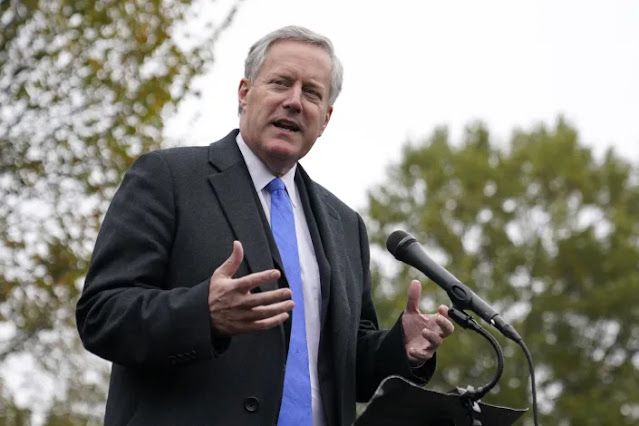
White House chief of staff Mark Meadows speaks with reporters outside the White House, Oct. 26, 2020, in Washington. Meadows, who as chief of staff to President Donald Trump promoted his lies of mass voter fraud, is facing increasing scrutiny about his own voter registration status. Public records show he is registered to vote in two states, including North Carolina, where he listed a mobile home he did not own, and may never have visited, as his legal residence weeks before casting a ballot in the 2020 election.

Attorney General Josh Stein's office asked the State Bureau of Investigation to look into Meadows' voter registration after a local prosecutor requested that state authorities oversee any probe of the matter, N.C. Department of Justice spokeswoman Nazneen Ahmed said in an email.

“We have asked the SBI to investigate and at the conclusion of the investigation, we’ll review their findings,” Ahmed said.

In a letter Monday, Macon County District Attorney Ashley Welch asked the attorney general's office to handle any probe into Meadows' voter registration and said that she would recuse herself from the matter. She noted that Meadows, a former congressman from the area, contributed to her campaign for DA and appeared in political ads endorsing her.

She also said she had no knowledge of the case until it was reported in the media.

“Until being contacted by the media, I was unaware of any allegations of voter fraud surrounding Mark Meadows,” she said

Welch's office released the letter Thursday and declined further comment.

A spokesman for Meadows didn’t immediately return an email seeking comment Thursday.

WRAL-TV first reported that state authorities are investigating Meadows' voter registration.

Public records show that Meadows is registered to vote in two states, including North Carolina, where he listed a mobile home he did not own as his legal residence weeks before casting a ballot in the 2020 presidential election.

Meadows listed a mobile home in Scaly Mountain, North Carolina, as his physical address on Sept. 19, 2020, while he was serving as Trump’s chief of staff in Washington, D.C. Scaly Mountain is just north of the Georgia-North Carolina border and about 90 miles (145 km) west of Asheville.

Meadows later cast an absentee ballot for the general election by mail. Trump won the battleground state by just over 1 percentage point.

The New Yorker, which first reported the questions about Meadows' voter registration, interviewed the current and former owner of the Scaly Mountain property. The previous owner said Meadows’ wife rented the property “for two months at some point within the past few years” but only spent one or two nights there. Neighbors said Meadows was never present, The New Yorker reported.

Public records indicate Meadows registered to vote in Alexandria, Virginia, almost exactly one year after he registered in Scaly Mountain and just weeks before Virginia’s high-profile governor’s election last fall.

Meadows frequently raised the prospect of voter fraud before the 2020 presidential election, as polls showed Trump trailing Joe Biden, and in the months following Trump’s loss to suggest Biden was not the legitimate winner. He repeated those baseless claims that the election was stolen in his 2021 memoir.

Monday, March 14, 2022

Alabama’s only Black member of Congress welcomes a fight over her voting rights bill

In August, Rep. Terri Sewell stood at the foot of the Edmund Pettus Bridge in her hometown, Selma, Alabama, to tout H.R. 4, the John R. Lewis Voting Rights Advancement Act.

Sewell, currently Alabama's only Black member of Congress and the delegation’s only Democrat, had high hopes after she introduced the legislation named in honor of her late mentor and friend.

The House voted soon afterward to pass the bill, but it stalled in the Senate last year. In January, a modified measure called the Freedom to Vote: John R. Lewis Act failed to clear the chamber.

“We’re at a great inflection point in our nation’s history,” said Sewell, a Harvard-educated lawyer who was first elected in 2010. “We have to remember John’s words: ‘Ours is the struggle of a lifetime, or maybe even many lifetimes, and each one of us in every generation must do our part.’”

Sewell returned home this month and headed to the infamous bridge for the 57th commemoration of Bloody Sunday.

On March 7, 1965, Selma was catapulted into the nation’s consciousness. Hosea Williams of the Southern Christian Leadership Conference and Lewis, then the chairman of the Student Nonviolent Coordinating Committee, led more than 500 peaceful protesters over the bridge en route to the State Capitol. The march was sparked by the killing of a young local man, Jimmie Lee Jackson, and demands around the right to vote.

Armed state troopers and a deputized posse met the men, women and children with brute force, firing tear gas and swinging billy clubs, bullwhips and cattle prods. The violence was captured on television and in newspaper images. A second march was cut short, but weeks later, Martin Luther King Jr. led thousands of nonviolent demonstrators who completed the 50-mile march from Selma to Montgomery, where a rally took place on the State Capitol steps. Their actions spurred passage of the Voting Rights Act of 1965.

The weekend of March 7 marked another anniversary for that pivotal chapter of the civil rights movement, as hundreds congregated for the annual Selma Bridge Crossing Jubilee. The event drew Vice President Kamala Harris and Cabinet members, members of Congress, relatives of King and Lewis, activists and people from around the country.

“Today, we stand on this bridge at a different time,” Harris said, calling the site “hallowed” ground. “We again, however, find ourselves caught in between — between injustice and justice, between disappointment and determination — still in a fight to form ‘a more perfect union.’ And nowhere is that more clear than when it comes to the ongoing fight to secure the freedom to vote.”

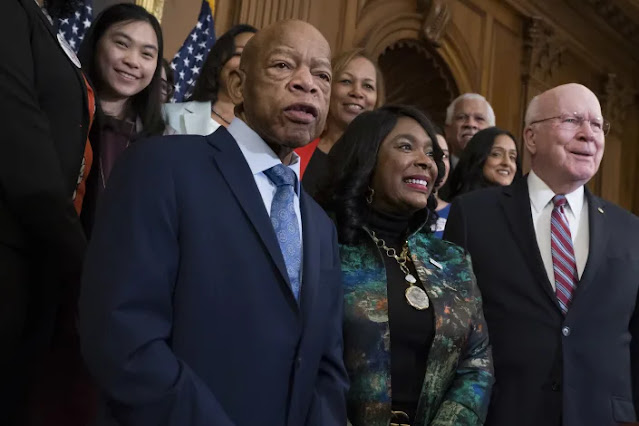
Civil rights leader Rep. John Lewis, D-Ga., Rep. Terri Sewell, D-Ala., and Sen. Patrick Leahy, D-Vt.

For Sewell, “voting rights are deeply personal.” A native of Alabama’s so-called Black Belt, she has roots that run as deep as the rich black soil that helped define the region. She was raised with two brothers by a librarian mother and a father who was a teacher and coach.

“I’m a daughter of Selma,” said Sewell, whose 7th Congressional District also includes Birmingham, Montgomery and Tuscaloosa, as well as smaller rural enclaves. “I stand on the shoulders of freedom fighters and foot soldiers.”

One of them was Amelia Boynton Robinson, the organizer who in 1964 became the first Black woman to seek a congressional seat in Alabama. She was beaten unconscious during the bridge protest. In 2015, Boynton was Sewell’s guest at President Barack Obama’s penultimate State of the Union address. “She joined the march that year and died months later at 103,” Sewell said.

On that fateful morning decades before, Boynton and fellow marchers started out at Brown Chapel African Methodist Episcopal Church in Selma. Sewell’s family has worshiped at the church, now a national historic landmark, for decades. It was where she first met Lewis and many in the movement as a youngster.

After Sewell’s historic election to Congress, Lewis became a mentor on Capitol Hill and a close friend. She fondly called him the “Boy from Troy,” referring to King’s nickname for Lewis, a native of Troy, Alabama. Lewis dubbed his protégé the “Girl from Selma” in return.

They served together on the powerful House Ways and Means Committee; Sewell was recently named a co-chair of its new Racial Equity Initiative. In 2013, the two sat side by side in the gallery as the Supreme Court heard oral arguments in the case Shelby County v. Holder. For decades, the Voting Rights Act helped ensure equal access at the ballot box by requiring states and localities with histories of voter discrimination to get preclearance from the Justice Department before they could change their voting laws.

The Shelby case stripped “key provisions” of the landmark legislation, Sewell said. Then, last year, “the court’s ruling on Brnovich v. DNC” further gutted the law.

According to the Brennan Center for Justice at New York University School of Law, legislatures have introduced more than 400 bills in 49 states that Democrats contend would restrict access to the ballot and disproportionately affect voters of color. The GOP and supporters have termed them voter integrity measures, and dozens have become law.

In Alabama alone, 23 bills have been introduced “that would allow for excessive voter purging, permit racial and partisan gerrymandering, and encourage voter intimidation, and implement stricter voter I.D. requirements,” leaders of multiple civil rights organizations said a recent statement.

Sewell said bolstering federal voting law is especially critical given the 2022 midterm elections and the congressional redistricting cycle.

The Supreme Court halted a lower court order last month requiring Alabama to redraw its new congressional map. Last year, a panel of federal judges struck down the map because it did not provide for two majority-minority districts. While Black people are about 27 percent of Alabama’s population, they are represented in only one of its seven congressional seats.

“The court order is yet another blow to the fight for fair Black political representation that is at the heart of the Voting Rights Act of 1965,” said Sewell, a co-chair of the Congressional Voting Rights Caucus and a co-chair of the Congressional Black Caucus’ Voting Rights Task Force. “The ruling allows the votes of Black Alabamians to be diluted and further undermines Section 2 of the VRA.”

Previous versions of H.R. 4 have also passed the House but faltered in the Senate. The bill was renamed for Lewis after his death on July 17, 2020. It would restore a section of the Voting Rights Act that stopped discriminatory voting changes before they were implemented, restore another section to remedy denial of voting or dilution of the right of people of color to vote, expand voting access (that is, early voting and same-day voter registration), establish Election Day as a federal holiday, ensure access for people with disabilities and more.

“It would re-establish much-needed federal oversight to ensure that minority voters are fairly represented,” Sewell said.

While advancing federal voting rights has been a major focus for Sewell, so have issues like jobs, education and health care access.

Helping her constituents access Covid-19 care and other health conditions has also been a priority. She watched her father, Andrew Sewell, who died in 2017, battle a series of strokes. Her mother, Nancy Gardner Sewell, the first Black woman on Selma’s City Council, died in June. Like Lewis, she had pancreatic cancer.

Sewell is lead sponsor of a measure that would help ensure that new, innovative blood-based cancer screenings are covered by Medicare after they are approved by the Food and Drug Administration. She was invited to the White House for President Joe Biden’s announcement of the relaunch of the Cancer Moonshot.

Sewell, who also holds degrees from Princeton and Oxford, has championed Alabama schools and colleges. As vice chair of the Bipartisan Congressional HBCU Caucus, she has sought increased funding and support for Tuskegee University, Alabama State University and other nearby institutions.

Ever mindful of the sacrifices of civil rights heroes — many of them unsung — she says she views what has transpired around voting rights as a roadblock, not the end of the road. For example, New York is considering its own version of the John R. Lewis Voting Rights Act.

Sewell, who is up for re-election this year, vowed that if voters return her to the 118th Congress, she plans to reintroduce the bill.

“Change rarely comes in the halls of Congress without agitation,” said Sewell, who said she believes senators have to be pressured and that the public must “mobilize, organize” to revamp voting rights. “We can be disappointed or frustrated. But we must never be deterred. Your vote does matter.

“History doesn’t end here,” she added. “As long as I have breath in my body, I will continue to fight for voting rights.”

Sunday, March 13, 2022

Pence fine tunes a message for 2024: Pro-Trump, to a point

In the past five weeks, former Vice President Mike Pence has broken with former President Donald Trump in more ways and more times than at any point in the previous five years.

Al Drago

That’s no coincidence.

The once loyal number two has been carefully uncoupling himself from Trump as he girds for a potential presidential bid in 2024. Speaking to Republican donors last weekend as Russian President Vladimir Putin’s unprovoked attack on Ukraine ravaged the democratic nation, Pence said, “There is no room in this party for apologists for Putin.” That unmistakable swipe at Trump — who had recently called Putin’s tactics leading up to the invasion “genius” — came after an even more direct condemnation.

“President Trump is wrong,” he said in a speech last month, responding to Trump’s argument that Pence could have overturned the 2020 election results by refusing to certify the electors.

It’s a marked shift from Pence’s deferential posture as vice president, when he was so wary of appearing out of step with his boss that he’d review speech drafts submitted by his aides and edit in Trump’s name with a Sharpie to be sure the president was getting enough credit, according to a former administration official.

But if Pence enters the 2024 presidential race, he’d need a rationale that distinguishes him from others, including Trump, a possible candidate himself. Some Pence allies say, and his recent moves suggest they're right, that Pence is settling on an a la carte approach: embracing parts of Trump’s record while rejecting others.

“He’s doing a good job of highlighting the successes of the [Trump] administration and, when it comes to Jan. 6, and, more recently, comments on Putin, he’s drawing that line,” a person close to Pence said, requesting anonymity to discuss private deliberations. Pence’s argument, this person said is, “If you like the policies of the Trump administration but not the rest of the stuff, then I’m the guy who’s going to fight for it.”

Pence has been giving speeches across the country since leaving office, mixing pointed attacks on President Joe Biden with a defense of the Trump administration’s efforts to cut taxes, reduce regulations and safeguard the southern border. He got a laugh from an audience at Stanford University last month when, as a prank, a student asked him about the location of the nearest bathroom. "Hey, this is a real thing,” Pence said. "President Harry Truman said, ‘Don’t ever pass up the opportunity to use the restroom.’” At the same time, he’s drawn his sharpest contrasts with Trump yet over Russia and a 2020 election the ex-president continues to falsely insist he won.

Another way Pence may differentiate himself in a presidential race is by reverting to a more traditional Republican platform, a second person close to him said. Under Trump, the GOP took a different turn as the former president courted authoritarian leaders and considered withdrawing from NATO, the military alliance that has been a bulwark against Russia for decades. Pence would champion more classic GOP positions while stressing the value of democratic governance, this person said. Firming up his foreign policy credentials, Pence last week met with Israeli Prime Minister Naftali Bennett and also toured the Poland-Ukraine border with his wife, Karen.

"It's going to be OK," Pence told a Ukrainian refugee carrying a small child, according to a video of his comments.

Making repeated appearances in early presidential primary states, Pence looks and sounds like a candidate-in-waiting. South Carolina, which typically holds the first presidential primary in the South, is becoming something of a home base. Pence is scheduled to give a commencement address in the state at the end of April and return in the first week in May to deliver a keynote speech at a Christian pregnancy center. South Carolina’s large evangelical population is a natural constituency for the former vice president, who describes himself as a Christian first, a conservative second and a Republican third.

The presidency is “not something that he’s thinking about, but if that time comes, then he’s said he and Karen will consider it and will pray on it,” said an aide for Advancing American Freedom, an issue advocacy group Pence founded, speaking on condition of anonymity.

Still, Pence's positions of late show “he is moving inexorably toward running in 2024 and maybe has already made that decision,” John Bolton, former national security adviser who served with Pence in the White House, said in an interview.

In doing so he risks making a permanent enemy of Trump, if he hasn’t already. But he appears to be on the right side of public opinion, including among the GOP. A Quinnipiac poll last month suggested that 52 percent of Republicans believed that Pence’s view that he had no authority to overturn the 2020 election results was closer to their own view than Trump’s, which was that Pence did have such power.

As for Russia, Trump still faces criticism for an interview he gave last month in which he said Putin showed “genius” and “savvy” for recognizing two Moscow-backed breakaway regions in the eastern part of Ukraine as independent, a step that was quickly followed by troops moving into those regions ahead of a full-scale invasion.

"He was wrong, pretty obviously," Sen. Mitt Romney, R-Utah, said in an interview.

Praise for Putin appears out of step with both American voters and Republican Party leaders who sympathize with Ukraine’s plight. A Reuters/Ipsos poll earlier this month found the vast majority of Americans favored aggressive measures to help Ukraine fend off the Russian attack. Nearly three-quarters said the U.S. and its allies should set up a no-fly zone in Ukraine, an escalatory step that the Biden administration has refused to take.

“Anyone who associates themselves with any positive comments about Putin isn’t being very smart, if you look at how everyone is aghast at what’s going on in Ukraine,” said John Kelly, Trump’s longest-serving White House chief of staff.

The midterm elections in November present a fresh opportunity for Pence to move out from under Trump’s huge shadow and expand his own political network. His advocacy group announced last week it was pumping $10 million into an ad campaign aimed at 16 different Democratic House members that urges them to expand domestic oil production, among other actions. The ad buy could help him win the gratitude of Republican lawmakers in tough re-election fights. More ads will be coming, the aide to the group said.

It is unclear how much money Trump plans to invest in midterm campaigns from the $120 million-plus war chest he’s amassed. One national GOP strategist worried that it would be too little, too late.

“No one is banking on that $120 million coming in,” the strategist said, speaking on condition of anonymity to talk more freely. “It’s not something that people are assuming is going to be there.”

Trump has made a slew of endorsements as he looks to oust sitting Republican officials he has deemed disloyal. The gambit has the potential to backfire if his endorsed candidates don’t win. In the Georgia governor’s race, for example, Trump has endorsed former Sen. David Perdue, who’s running against incumbent Brian Kemp in the Republican primary. Kemp angered Trump by upholding the 2020 election result in which Trump lost the state. By contrast, Pence has vowed to support all incumbent Republican governors, even if they’re challenged by candidates Trump has endorsed. Kemp was leading Perdue by 11 points in a recent Fox News poll.

In a Republican National Committee podcast, chair Ronna McDaniel asked Trump what he planned to do to help Republicans recapture the House and Senate in the midterm elections. Trump mentioned that he would be holding rallies — his favorite forum. A spokesman for Trump did not respond to a request for comment.

Pence is “making decisions completely separate from what Trump is doing,” the second person close to Pence told NBC News.

Pence seldom revealed his thinking in meetings and waited instead until he was alone with Trump, former officials have said. Now he is writing two books that will help reintroduce himself to voters on his terms. One will focus on his work in the conservative movement over the years; another will be devoted to his vice presidency.

“I’m sure it will tell stories previously untold,” the Pence advocacy group aide said. “But it will also pull back the curtain on the many successes the Trump-Pence administration had, and his involvement in them.”

Other ex-officials who ran afoul of Trump, such as former Attorney General William Barr and former press secretary Stephanie Grisham, have come out with books that have had a retaliatory flavor.

It’s not Pence’s style to write a tell-all, but “the person who could give Donald Trump the most headaches could be Mike Pence,” a third person close to him said.

Airstrikes near Lviv come as Russian forces expand west

The Russian airstrikes on a military base near the northwestern city of Lviv come as Russian forces have been expanding their offensive in Ukraine to the west.

Airstrikes near Lviv come as Russian forces expand west

On Friday, Russian forces attacked airports in the far west of the country, which had previously been spared from the conflict.

There was substantial damage to the airport at Lutsk in northwestern Ukraine, some 70 miles from the Polish border. The Governor of Volyn region said four missiles had been fired from a Russian bomber and two people were killed Friday. Plumes of smoke also rose from the military airfield at Ivano-Frankivsk, western Ukraine, which was struck by missiles. 

Lviv is a cultural hub of Ukraine and the city's historic center is a UNESCO World Heritage Site. It is also a waypoint for those displaced by war, with thousands of people pouring into the city to escape bombarded towns and cities across the country or to make their way to the Polish border about 43 miles (70 kilometres) away. 

Russia intensifies strikes around Kyiv as it warns US against arming Ukraine

The Russian assault across Ukraine raged Saturday as explosions were heard in Kyiv and fighting intensified around the capital. Hours later, Russia warned the United States that it would fire on weapon shipments to Ukraine, raising the risk of direct confrontation between Moscow and a NATO country.

A number of major cities are under pressure as Russian strikes hit civilian structures. Smoke rose east of the river in Dnipro early on Saturday where CNN journalists felt at least two explosions and saw the cloudy remnants of what looked like anti-aircraft fire.

A large swath of Makariv, a village 30 miles west of Kyiv, has sustained significant damage from apparent Russian airstrikes.

CNN geolocated and verified the authenticity of photos, posted to social media Saturday, which show major damage to apartment complexes, schools and a medical facility. One of the more stark images from Makariv shows a large hole in the northern wall of an apartment building from a military strike. Many of the buildings in the photos have sustained damage on their northern facades, evidence that points to military strikes that hit them as being Russian.

In Chernihiv, some 100 kilometers north of Kyiv, local landmark Hotel Ukraine was hit overnight. "I am here now. There is no hotel anymore," Vyacheslav Chaus, head of Chernihiv region administration, said Saturday.

The northern city, which is close to the Belarus border, has been surrounded by Russian forces for more than a week and video from the city showed the collapsed floors of the hotel as well as widespread damage from missiles and airstrikes.

Chaus said civilians were dying from the strikes, which brought down the city's electricity network. "Many people are being injured. The enemy shells civilian infrastructure, where there is no military," he said, saying the city has "no electricity, almost no water, gas, and heat."

The Russian Ministry of Defense has repeatedly claimed that Russian forces are not targeting civilians.

Ukrainian President Volodymyr Zelensky said in a Saturday address the whole country was now a front line. "A few small towns just don't exist anymore. And this is a tragedy. They are just gone. And people are also gone."

Zelensky said negotiations to end Russia's invasion of Ukraine "must begin with a ceasefire," adding that Ukraine has lost about 1,300 troops as of Saturday. CNN has been unable to independently verify these numbers.

Later Saturday, Zelensky said that he was grateful for international support but urged allies to provide more aid.

"I keep reiterating to our allies and friends abroad; they have to keep doing more for our country, for Ukrainians and Ukraine. Because it is not only for Ukraine, but it is for all of Europe," he said. "The evil which purposefully targets peaceful cities and ambulance vans and explodes hospitals will not stop with just one country if they have the strength to keep going."

The US and NATO say they're taking steps to help Ukraine defend itself against Russian troops, and they have continued to provide Ukraine with security assistance, including anti-tank and anti-aircraft weapons. But the US and NATO have also tried to avoid being drawn into an outright conflict with Russia. US President Joe Biden emphasized that point on Friday, that the US will not send ground troops into Ukraine, which is not a member of NATO. 

"We will not fight the third world war in Ukraine," Biden said after reiterating the US' full support to its NATO allies and promising that the US will defend "every inch" of NATO territory.

"I want to be clear though, we are going to make sure that Ukraine has the weapons to defend themselves from an invading Russian force. And we will send money and food aid to save Ukrainians' lives," he added.

Russian Deputy Foreign Minister Sergei Ryabkov on Saturday warned the US against transferring weapons to Ukraine, saying convoys with foreign weapons would be considered "legitimate targets."

"We warned the United States that pumping Ukraine with weapons from a number of countries orchestrated by them is not just a dangerous move, but these are actions that turn the corresponding convoys into legitimate targets," Ryabkov said Saturday on the Russian state-run Channel One, according to state-owned RIA Novosti news agency.


Determined resistance

In Ukraine, Russia has faced defiance from the public in the past two weeks. On Saturday, several hundred people swarmed the city hall in the southern Ukrainian city of Melitopol following the detention of its mayor, Ivan Fedorov, by armed men the day before.

Shortly after Fedorov's detention, the Russian-backed Luhansk regional prosecutor claimed Fedorov had committed terrorism offenses, allegations that Zelensky called a "crime against democracy" on Saturday.

The Zaporozhye regional administration said Saturday a new mayor had been installed. Galina Danilchenko, a former member of the Melitopol city council, was introduced as the acting mayor on local TV, according to a statement from the regional administration posted on Telegram. In her televised statement, Danilchenko said that her "main task is to take all necessary steps to get the city back to normal."

She claimed there were people still in Melitopol who would try to destabilize "the situation and provoke a reaction of bad behavior."

"I ask you to keep your wits about you and not to give in to these provocations," she said. "I appeal to the deputies, elected by the people, on all levels. Since you were elected by the people, it is your duty to care about the well-being of your citizens."

In Kyiv, Russia's advance has faced stiff resistance from Ukrainian forces. On Saturday, the UK's Ministry of Defence's latest intelligence assessment said the bulk of Russian ground forces were about 25 kilometers (15.5 miles) from the center of the Ukrainian capital.

In Berestyanka -- 10 miles west of the airbase -- a number of fuel trucks and what Maxar says appear to be multiple rocket launchers are seen positioned in a field near trees.

Maxar satellite imagery taken on Thursday showed that the 40-mile Russian column northwest of Kyiv had largely dispersed and regrouped. But the intelligence assessment warned, "this is likely to support a Russian attempt to encircle the city. It could also be an attempt by Russia to reduce its vulnerability to Ukrainian counter attacks, which have taken a significant toll on Russian forces."

The north and northeastern cities of Chernihiv and Sumy, the eastern city of Kharkiv, and Mariupol in the south, remain encircled by Russian forces, the ministry added.

A senior Ukrainian official in the southern region of Kherson, now in Russian control, has said that the "occupiers" are pressing the regional council to agree to a referendum on the area's "independence" from Ukraine. There's been no word from the Russian side about any referendum plans.

Similar referendums were held after Russian-backed separatists took control in 2014 of parts of the Luhansk and Donetsk regions. People's Republics were later declared in both regions.

Ukraine's state-operated nuclear energy company said Saturday that Russian officials had arrived at Ukraine's largest nuclear power plant, Zaporizhzhya, demanding to take control of the facility. 

Zaporizhzhya has been occupied by Russian forces for more than a week now, with Energoatom previously claiming its employees had been forced to work at "gunpoint." Chernobyl nuclear power plant is also under the control of Russian forces.

Despite the onslaught, Zelensky claimed on Saturday that Ukrainian forces are inflicting the "biggest blow to Russia's army in decades," saying that 31 Russian tactical battalion groups had lost capability, and more than 360 Russian tanks have been lost.

Zelensky added that groups of Russian troops were surrendering to Ukrainian forces, but that Russia is now recruiting fighters, reservists, conscripts, and mercenaries to "outnumber" Ukrainian forces.

Russia's losses include Major General Andriy Kolesnikov, the third Russian general to have been killed by Ukrainian forces, a Western defense official confirmed on Friday. He was commander of the Eastern Military District, according to the Russian Ministry of Defense's website, and the Western official noted for context that three Russian general staff officers were killed during the whole Syrian conflict. 


Deteriorating conditions

As Russia sustains losses, its bombardment of the country continues to degrade living conditions in several areas. Officials are now racing to send aid and evacuate citizens from encircled cities.

Ukrainian officials announced a fresh attempt to secure at least 13 evacuation corridors from different cities, despite reporting that only a few civilians could leave the previous day.

Addressing the besieged city of Mariupol, Zelensky said Saturday that Ukrainian forces would guarantee a ceasefire along an evacuation corridor so supplies could enter, and civilians can leave.

Ukrainian emergency employees and volunteers carry an injured pregnant woman from a maternity hospital that was damaged by shelling in Mariupol, Ukraine, Wednesday, March 9, 2022.

With relatively clear skies over Mariupol, new satellite imagery taken Saturday morning from Maxar showed the extent of the damage there, including some caused by military strikes reported earlier in the week.

In Mariupol's western neighborhood of Zhovteneyvi, a large -- still smoldering -- crater was seen near the Okko gas station. Smoke appeared to be rising from an apartment complex across the street. The roofs of warehouses down the street also appeared to have large holes from military strikes.

Within the apartment complex, several buildings seemed to have sustained significant damage. A debris field was seen surrounding some of the buildings with a large smoke plume.

Just northwest of the gas station, an additional satellite image showed impact craters dotting a snow-covered field. Vehicle tread marks were also seen. Just more than a mile south, in an industrial area in the Primorskyi neighborhood, a large fire was seen raging.

There was some good news amid the destruction. A pregnant woman, whose rescue from the Mariupol maternity hospital this week was captured in a viral AP photo, gave birth to a baby girl, her family told CNN.

Mariana Vishegirskaya was among a number of women at the Mariupol maternity hospital who survived the shelling.

Her aunt Tatiana Liubchenko said the baby was named Veronica but she was worried about the situation in the city. "We got the information that the water and food of the people there are running out and we are very worried, because the green corridor is not opened and the Russians do not allow, the food does not come. And it's so cold there right now so they can't get warm," Liubchenko said.

The fighting has displaced around 2 million Ukrainians in the country, the UN said Friday, and 2.5 million people have fled its borders.

Florida lawmakers fail to pass safety legislation after Surfside tragedy

The Florida legislature failed to strike agreement on legislation targeting condo safety measures months after the partial collapse of a Surfside, Fla., condo building that left close to 100 people dead.

The proposed legislation required condo buildings to conduct "reserve studies" where engineers inform condo boards about how much money they recommend setting aside after doing periodic inspections. It also required condo inspections on aging buildings.

Florida lawmakers fail to pass safety legislation after Surfside tragedy

The measure failed to make headway between both chambers of the Florida legislature on Friday.

Older condo buildings are not required to undergo safety inspections under current Florida law, the network noted.

The news comes after state lawmakers vowed to take action on preventative steps for the future in the wake of the collapse.

"I'm not sure why it fell apart," Senate President Wilton Simpson (R) said at a news conference, according to NBC News.

"Clearly, we did not get together with the House on that bill, and so unfortunately it did not pass."

Lawmakers in the Senate struggled to overcome an impasse on the bill sponsored by state Rep. Daniel Perez (R) that would stop condo boards from waiving reserve funding, targeting a current loophole in Florida. But state senators argued condo owners would be financially burdened, the network reported.

"Many associations did not want the inability to waive reserves. And I think that they had a little bit more of an influence in the Senate than they did in the House," Perez told NBC News. "That was not a negotiable piece for us. We were never going to negotiate the waiving of reserves, because that is part of the problem that caused the incident at Surfside."

The impasse comes months after 98 people died in the partial Surfside condo collapse. The tragedy gripped newscasts as Florida officials regularly updated the public on its investigation and rising death toll.

It also became a rare sign of bipartisan unity between President Biden and Florida Gov. Ron DeSantis (R), who met together in South Florida following the tragedy.

US pays $2M a month to protect Pompeo, aide from Iran threat

The State Department says it’s paying more than $2 million per month to provide 24-hour security to former Secretary of State Mike Pompeo and a former top aide, both of whom face “serious and credible” threats from Iran.

The department told Congress in a report that the cost of protecting Pompeo and former Iran envoy Brian Hook between August 2021 and February 2022 amounted to $13.1 million. The report, dated Feb. 14 and marked “sensitive but unclassified,” was obtained by The Associated Press on Saturday.

Former Secretary of State Mike Pompeo, speaks at the Conservative Political Action Conference (CPAC) Friday, Feb. 25, 2022, in Orlando, Fla. The State Department says it's paying more than $2 million per month to provide 24-hour security to Pompeo and a former top aide, both of whom face “serious and credible” threats from Iran. That's according to a report sent to Congress last month and obtained by The AP on Saturday, March 12.

Pompeo and Hook led the Trump administration’s “maximum pressure” campaign against Iran and the report says U.S. intelligence assesses that the threats to them have remained constant since they left government and could intensify. The threats have persisted even as President Joe Biden's administration has been engaged in indirect negotiations with Iran over a U.S. return to a landmark 2015 nuclear deal.

As a former secretary of state, Pompeo was automatically given 180 days of protection by the State Department’s Bureau of Diplomatic Security after leaving office. But that protection has been repeatedly extended in 60-day increments by Secretary of State Antony Blinken due to “a serious and credible threat from a foreign power or agent of a foreign power arising from duties performed by former Secretary Pompeo while employed by the department,” the report said.

Hook, who along with Pompeo was often the public face of the Trump administration's imposition of crippling sanctions against Iran, was granted the special protection by Blinken for the same reason as Pompeo immediately after he left government service. That has also been repeatedly renewed in 60-day increments.

The latest 60-day extensions will expire soon and the State Department, in conjunction with the Director of National Intelligence, must determine by March 16 if the protection should extended again, according to the report.

The report was prepared because the special protection budget will run out in June and require a new infusion of money if extensions are deemed necessary.

Current U.S. officials say the threats have been discusses in the nuclear talks in Vienna, where Iran is demanding the removal of all Trump-era sanctions. Those sanctions include a “foreign terrorist organization” designation of Iran's Islamic Revolutionary Guard Corps that Pompeo and Hook were instrumental in approving.

The Vienna talks had been expected to produce an agreement soon to salvage the nuclear agreement that President Donald Trump withdrew the U.S. from in 2018.

But the talks have been thrown into doubt because of new demands made by Russia and a small number of unresolved U.S.-Iran issues, including the terrorism designation, according to U.S. officials.

Saturday, March 12, 2022

Justice Thomas slams cancel culture, 'packing' Supreme Court

U.S. Supreme Court Justice Clarence Thomas said he's concerned efforts to politicize the court or add additional justices may erode the institution's credibility, speaking Friday in Utah at an event hosted by former Republican U.S. Sen. Orrin Hatch’s foundation.

In this Nov. 30, 2018 photo, Supreme Court Associate Justice Clarence Thomas sits for a group portrait at the Supreme Court Building in Washington. Justice Thomas participated at a "fireside" chat in Salt Lake City hosted by former Sen. Orrin Hatch's foundation, Friday, March 11, 2022.

Thomas, the most senior justice on the nine-member court, said he often worries about the long-term repercussions of trends such as “cancel culture” and a lack of civil debate.

“You can cavalierly talk about packing or stacking the court. You can cavalierly talk about doing this or doing that. At some point the institution is going to be compromised,” he told an audience of about 500 people at an upscale hotel in Salt Lake City.

"By doing this, you continue to chip away at the respect of the institutions that the next generation is going to need if they’re going to have civil society," Thomas said.

Rulings for the upcoming year will set laws on hot-button political issues, including abortion, guns and voting rights.

The court has leaned increasingly conservative since three justices nominated by former President Donald Trump joined its ranks. Progressives have in turn called to expand the number of justices on the court, including during the 2020 presidential primary. Democrats in Congress introduced a bill last year to add four justices to the bench, and President Joe Biden has convened a commission to study expanding the court.

“I’m afraid, particularly in this world of cancel culture attack, I don’t know where you’re going to learn to engage as we did when I grew up,” he said. “If you don’t learn at that level in high school, in grammar school, in your neighborhood, or in civic organizations, then how do you have it when you’re making decisions in government, in the legislature, or in the courts?”

In addition to condemning “cancel culture,” Thomas also blasted the media for cultivating inaccurate impressions about public figures — including himself, his wife and late Supreme Court Justice Antonin Scalia.

Ginni Thomas, Justice Thomas’s wife and a longtime conservative activist, has faced scrutiny this year for her political activity and involvement in groups that file briefs about cases in front of the Supreme Court, as well as using her Facebook page to amplify partisan attacks.

As Congress prepares to hold confirmation hearings for Judge Ketanji Brown Jackson, Thomas recalled his 1991 confirmation process as a humiliating and embarrassing experience that taught him not to be overly prideful. During congressional hearings, lawmakers grilled Thomas about sexual harassment allegations from Anita Hill, a former employee, leading him to call the experience a “high tech lynching.”

If confirmed, Jackson would be the first Black woman on the court, and would join Thomas as its second Black justice.

Thomas, who grew up in Georgia during segregation, said he held civility as one of his highest values. He said he learned to respect institutions and debate civilly with those who disagreed with him during his years in school. Based on conversations he’s had with students at his university lectures in recent years, he said he doesn’t believe colleges are welcoming places for productive debate, particularly for students who support what he described as traditional families or oppose abortion.

Thomas did not reference the future of Roe v. Wade, the landmark 1973 Supreme Court decision that extended abortion rights throughout the country. The court this year is scheduled to rule on Dobbs v. Jackson Women’s Health Organization and whether Mississippi can ban abortions at 15 weeks. While the court deliberates over the case, lawmakers in Florida, West Virginia and Kentucky are advancing similar legislation hoping the court overturns Roe and establishes new precedent.

‘You will see the wrath’ — Progressives warn Biden against cutting down agenda

President Joe Biden’s vision for building a vast "care economy" has collapsed — and Democrats fear their party’s political advantage with parents and caregivers could end up as collateral damage.

More than a year into his term, Biden’s plan to invest hundreds of billions of dollars into child and eldercare programs is on the congressional backburner. An expanded tax credit that dramatically reduced child poverty expired and is unlikely to be revived. And the administration’s ambitions for guaranteeing free pre-kindergarten and paid family leave are struggling to gain widespread traction in Congress.

‘You will see the wrath’ — Progressives warn Biden against cutting down agenda

Making matters worse: There’s little public talk of resuscitating these items. In fact, Democrats seem to be girding themselves for a deal in which they are removed entirely from the president’s Build Back Better bill in favor of a pared-down version that funds climate change initiatives and reduces the deficit.

The situation has alarmed liberal advocates and unnerved Democrats who believe winning the support of parents is key to keeping control of power in Washington. Caregivers already exhausted by the pandemic now face rising prices due to historic inflation, with no relief in sight. Republicans, sensing an opening, are attempting to make fresh inroads on education and children’s issues — largely by waging campaigns around curriculums and sexual orientation and gender identification instructions in the classroom.

“They cannot return home for a midterm election without bringing home the goods,” said April Verrett, president of long-term care worker union SEIU Local 2015, who has met frequently with White House officials on the matter. “Americans want and need the support to lower costs for families.”

Democrats’ hopes on this front rely largely on winning over the party’s main holdout, Sen. Joe Manchin (D-W.Va.). But Manchin is focused on limiting drug prices and advancing climate programs, regarding the rest as “social” spending that should be considered only if there’s money left over. And after months spent trying to win the Senator’s elusive vote, many congressional Democrats are signaling they’re willing to give in to his demands.

Advocates for the care provisions have warned the White House and lawmakers that any reconciliation bill that leaves out large investments in the care economy risks alienating one of Democrats' most important voting groups ahead of the midterms. A Morning Consult/POLITICO poll conducted in February found that Democrats had already begun ceding their electoral advantage among recipients of the expanded child tax credit within a month of the payments expiring.

“If a reconciliation package passes without any of the care agenda items, you will see the wrath of women around the country,” said Julie Kashen, director of women’s economic justice at the Century Foundation.

And while members of Congress who have been working on caregiver issues continue to speak optimistically, they acknowledge the skepticism that a deal will be made.

"It will remain a big priority for us," said Rep. Brendan Boyle (D-Pa.). "But I am nervous about whether or not those provisions ultimately make it into something that can pass the Senate."

The current status of the expanded child tax embodies the vise Democrats now find themselves in. The program was passed as part of the Covid relief plan passed last spring, granting families up to $3,600 per child in monthly payments. But it expired in December. Then the main vehicle for its extension — the Build Back Better bill — faltered, and Congress is unlikely to strike a deal this year to restore it, even in a reduced fashion.

Two people close to the process blamed the lack of progress on GOP obstruction, along with Manchin’s reluctance to keep the program going despite its link to plunging child poverty rates. But they also said the administration is largely disengaged from negotiations on Capitol Hill.

There is no point person in charge of getting the expanded tax credit renewed, and the White House has refused to say what concessions it could accept to make a fix more palatable to Republicans and Manchin — making it difficult for lawmakers to hash out specifics. That's left some privately resigned to the probability an agreement is out of reach.

"I'm amazed at the lack of strategy," said one advocate in close touch with the White House. "There's a debate about the future of children and families going on, and they've taken a step back on it."

White House officials are aware of the concerns about the president’s care agenda and try to assuage those fears by saying the president will keep looking for ways to pass the issues into law if they don’t end up in the BBB bill that can be done through reconciliation. During a Friday speech to House Democrats, Biden pleaded with lawmakers to continue working on reducing childcare costs, insisting that "we can do that."

But avenues for passage through a 60-vote threshold in the Senate are, as of now, non-existent. And in a response to a series of questions about its strategy for advancing the issue, the White House declined to comment.

Others told POLITICO that the White House has continued to reassure them that there's still a chance of securing funding for certain items, like universal pre-K and capping childcare costs — emphasizing that the issues are still major priorities for Biden evidenced by their inclusion in his State of the Union address.

“There were a lot of things that were not included in that list of three priorities for Congress to address through a reconciliation bill that he wants on his desk,” said Charles Joughin, who leads public affairs for the child advocacy group First Five Years Fund.

Yet even under that scenario, progress could take months.

While the administration has carefully guarded the details of its talks with Manchin, for fear of leaks that could derail the delicate discussions, officials have indicated it may take until the end of April for negotiations on the specifics of an economic package to begin in earnest.

A person familiar with the White House’s thinking told POLITICO, “The White House is not setting deadlines.”

The delay means that Democrats are likely to head into the campaign stretch either still in the messy negotiation phase or having made little headway on a “care economy” initiative that once formed the backbone of Biden’s Build Back Better agenda.

The expanded child tax credit is hardly the only place where progress has faltered. The White House also initially sought funding to upgrade child care facilities and create a nationwide pre-K program. It wanted to guarantee 12 weeks of paid leave and cap the cost of childcare for low-to-middle income families. Another $400 billion was planned for home and community-based care for older Americans and people with disabilities.

Those initiatives would slash families’ biggest expenses and grow the economy overall, supporters argue, chiefly by allowing more stay-at-home caregivers to re-enter the workforce. Democrats also hoped it would aid them politically, shoring up support among those managing the brunt of the pandemic: suburban women voters who also helped Biden take the presidency in 2020 and people of color who make up a core part of the party’s base.

Instead, that early optimism has been replaced by warnings that Democrats are blowing it.

“Republicans are well aware that parents are going to be a highly contested demographic this cycle, and so they’ve ramped up culture war messaging aimed at this group,” said Ethan Winter, a senior analyst at progressive polling firm Data for Progress, pointing to GOP efforts in Congress and several states to redefine fights over school curricula, gender identity and Covid policies as "parents rights" issues.

There are signs the administration shares the urgency of the advocacy community. Earlier this week, a fact sheet circulated by the White House ahead of the one-year anniversary of its American Rescue Plan credited the law for driving child poverty to its lowest rate on record.

Yet that point is quickly losing its political salience. With the payments drying up, new Columbia University research indicates child poverty is on the rise again — especially among Latino and Black children who saw the greatest benefits last year.

On a Tuesday call with reporters to tout the law’s accomplishments, White House officials declined to say whether they saw a path to restoring the tax credit.

“This is something that we are still fighting for and haven’t given up,” a senior official said.

In the absence of clear momentum, some Democrats have pushed congressional leaders to hold voters on individual proposals even if they’re unlikely to pass, so lawmakers can at least register their support. But that tactic won’t do much to deliver the on-the-ground benefits that Biden promised — and that Democrats once hoped would boost their chances in November.

“We have to define what the parents agenda is,” said Celinda Lake, one of Biden’s campaign pollsters. “We need a more visible fight on this.”

Russia strikes near Ukraine's capital; mosque reported hit

Russian forces pounding the port city of Mariupol shelled a mosque sheltering more than 80 people, including children, the Ukrainian government said Saturday as fighting also raged on the outskirts of the capital, Kyiv.

There was no immediate word of casualties from the shelling of the elegant, city-center mosque. Mariupol has suffered some of the greatest misery from Russia's war in Ukraine, with unceasing barrages thwarting repeated attempts to bring in food and water, evacuate trapped civilians and to bury all of the dead.

A volunteer of the Ukrainian Territorial Defense Forces walks on the debris of a car wash destroyed by a Russian bombing in Baryshivka, east of Kyiv, Ukraine, Friday, March 11, 2022. (AP Photo/Felipe Dana)

The Ukrainian Embassy in Turkey said 86 Turkish nationals, including 34 children, were among the people who had sought safety in the mosque of Sultan Suleiman the Magnificent and his wife Roksolana. Opened in 2007 and modeled after a mosque in Istanbul, Turkey, the white-walled mosque and its towering minaret were proudly advertised as a popular scenic draw by city authorities before Mariupol became a target of Russian barrages.

Around Kyiv, artillery barrages in multiple areas sent residents scurrying for shelter as air raid sirens rang out across the capital region. Britain's Defense Ministry said Russian ground forces massed north of Kyiv for most of the war had edged to within 25 kilometers (15 miles) of the city center.

The massive column of Russian fighters also has spread out, likely to support an attempt to encircle Kyiv, the British ministry said.

Ukraine's military and volunteer forces have been preparing for a feared all-out assault. Kyiv Mayor Vitali Klitschko has said that about 2 million people, half the population of the metropolitan area, have left and that “every street, every house … is being fortified.”

As artillery pounded Kyiv’s northwestern outskirts, two columns of smoke – one black and one white -- rose southwest of the capital after a strike on an ammunition depot in the town of Vaslkyiv caused hundreds of small explosions. A frozen food warehouse just outside the capital also was struck in an apparent effort to target Kyiv’s food supply.

Russia's slow and grinding tightening of a noose around Kyiv and the bombardment of other population centers with artillery and air strikes mirror tactics that Russian forces have previously used in other campaigns, notably in Syria and Chechnya, to crush armed resistance.

Mariupol, with its strategic Black Sea port, has seen some of the greatest suffering. As of Friday, the death toll in Mariupol passed 1,500 during 12 days of attack, the mayor’s office said. A strike on a maternity hospital in the city of 446,000 this week that killed three people sparked international outrage and war-crime allegations.

The ongoing bombardment forced crews to stop digging trenches for mass graves, so the “dead aren’t even being buried,” the mayor said. An Associated Press photographer captured the moment when a tank appeared to fire directly on an apartment building, enveloping one side in a billowing orange fireball.

Russian forces have hit at least two dozen hospitals and medical facilities since they invaded Ukraine on Feb. 24, according to the World Health Organization. Ukrainian officials reported Saturday that heavy artillery damaged a cancer hospital and several residential buildings in Mykolaiv, a city 489 kilometers (304 miles) west of Mariupol.

The hospital’s head doctor, Maksim Beznosenko, said several hundred patients were in the facility during the attack but no one was killed.

The invading Russian forces have struggled far more than expected against determined Ukrainian fighters. But Russia's stronger military threatens to grind down the defending forces, despite an ongoing flow of weapons and other assistance from the West for Ukraine's westward-looking, democratically elected government.

A senior Russian diplomat warned that Moscow could target foreign shipments of military equipment to Ukraine. Speaking Saturday, Deputy Foreign Minister Sergei Ryabkov said Moscow has warned the United States "that pumping weapons from a number of countries it orchestrates isn’t just a dangerous move, it’s an action that makes those convoys legitimate targets."

Russia's troops are likely to see their ranks bolstered soon from abroad. Denis Pushilin, the Russia-backed head of a separatist region in eastern Ukraine, said Saturday that he expects “many thousands” of fighters from the Middle East to join the rebels and fight “shoulder-to-shoulder” against the Ukrainian army.

Russian Defense Minister Sergei Shoigu’s said Friday that Russian authorities have received request from over 16,000 people from the Middle East who are eager to join the Russian military action in Ukraine. He added that many of those people have previously fought together with Russia against the Islamic State group.

Thousands of soldiers on both sides of the war in Ukraine are believed to have been killed along with many civilians. At least 2.5 million people have fled the country, according to the United Nations refugee agency.

The Ukrainian chief prosecutor’s office said Saturday at least 79 children have been killed and nearly 100 have been wounded since the start of the war. most of the victims were in the Kyiv, Kharkiv, Donetsk, Sumy, Kherson and Zhytomyr regions, the office said, noting that the numbers aren’t final because active fighting continues.

On the ground, the Kremlin’s forces appeared to be trying to regroup and regain momentum after encountering tough resistance and amassing heavy losses over the past two weeks.

“It’s ugly already, but it’s going to get worse,” said Nick Reynolds, a warfare analyst at Royal United Services Institute, a British think tank.

Russian forces were blockading Kharkiv, Ukraine’s second-largest city, even as efforts have been made to create new humanitarian corridors around it and other urban centers so aid can get in and residents can get out.

Ukraine’s emergency services reported Saturday that the bodies of five people - two women, a man and two children - were pulled from an apartment building that was struck by shelling in Kharkiv,

The Russians' also stepped up attacks on Mykolaiv, located 470 kilometers (292 miles) south of Kyiv, in an attempt to encircle the city.

New commercial satellite images appeared to capture artillery firing on residential areas that stood between the Russians and the capital. The images from Maxar Technologies showed muzzle flashes and smoke from big guns, as well as impact craters and burning homes in the town of Moschun, 33 kilometers (20.5 miles) from Kyiv, the company said.

On the economic and political front, the U.S. and its allies moved to further isolate and sanction the Kremlin. President Joe Biden announced that the U.S. will dramatically downgrade its trade status with Russia and ban imports of Russian seafood, alcohol and diamonds.

The move to revoke Russia's “most favored nation” status was taken in coordination with the European Union and Group of Seven countries.

“The free world is coming together to confront Putin,” Biden said.

With the invasion in its 16th day, Putin said Friday that there had been “certain positive developments” in ongoing talks between Russian and Ukrainian negotiators. He gave no details.

Ukrainian President Volodymyr Zelenskyy appeared on video to encourage his people to keep fighting.

“It’s impossible to say how many days we will still need to free our land, but it is possible to say that we will do it," he said from Kyiv.

Zelenskyy also accused Russia of kidnapping the mayor of one city, Melitopol, calling the abduction “a new stage of terror.” The Biden administration had warned before the invasion of Russian plans to detain and kill targeted people in Ukraine. Zelenskyy himself is a likely top target.

American defense officials said Russian pilots are averaging 200 sorties a day, compared with five to 10 for Ukrainian forces, which are focusing more on surface-to-air missiles, rocket-propelled grenades and drones to take out Russian aircraft.

The U.S. also said Russia has launched nearly 810 missiles into Ukraine.

Until recently, Russia's troops had made their biggest advances on cities in the east and south while struggling in the north and around Kyiv. They also have started targeting areas in western Ukraine, where large numbers of refugees have fled.

Russia said Friday it used high-precision long-range weapons to put military airfields in the western cities of Lutsk and Ivano-Frankivsk “out of action.” The attack on Lutsk killed four Ukrainian servicemen, the mayor said.

Russian airstrikes also targeted for the first time Dnipro, a major industrial hub in the east and Ukraine’s fourth-largest city, with about 1 million people. One person was killed, Ukrainian officials said.

In images of the aftermath released by Ukraine’s emergency agency, firefighters doused a flaming building, and ash fell on bloodied rubble. Smoke billowed over shattered concrete where buildings once stood.

The United Nations political chief said the international organization had received credible reports that Russian forces were using cluster bombs in populated areas. International law prohibits the use of the bombs, which scatter smaller explosives over a wide area, in cities and towns.

‘Arsonists with keys to the firehouse’: once-obscure state races fuel fears for US democracy

Last year, Brad Raffensperger was attracting national headlines for taking a stand against Donald Trump and his lies about the 2020 election.

Photograph: Brynn Anderson/AP

In a phone call that was quickly made public, Trump demanded that Raffensperger, Georgia’s Republican secretary of state, “find” enough votes to deprive Joe Biden of a victory in the battleground state. Raffensperger refused to do so and won widespread praise for his courage.

Raffensperger is paying for his actions in a way that reveals how his once obscure elected position is now at the center of a battle for the future of American democracy – and attracting all the big money and political heat that entails.

This year, Raffensperger is facing a brutal primary race against a Trump-backed candidate, the US congressman Jody Hice, and trying to cling on to his job. Hice, who has said the 2020 results in Georgia would have been different if the race had been “fair”, has already raised more than twice as much money as Raffensperger.

Hice’s impressive haul is partly thanks to the unusually high number of out-of-state donations that his campaign has attracted, as more Americans across the country zero in on secretary of state races.

And Georgia is not unique. As Trump and his allies continue to spread the “big lie” of widespread fraud in the 2020 race, many voters are focusing their attention – and wallets – on the officials who oversee states’ elections.

Secretary of state candidates in both parties are now posting substantial fundraising figures, intensifying concerns over how election administration has become a heated political issue in the US.

Secretary of state races have historically attracted little notice and even less money. The winners of these elections assume rather bureaucratic roles, and their duties may include managing state records, overseeing the department of motor vehicles and keeping the state seal. But in many states, the secretary of state also serves – crucially – as the chief election official.

In the weeks after the 2020 election, as Trump and his supporters falsely claimed the results had been tainted by fraud, secretaries of state in key battleground states became the target of intimidation and threats. Now the former president is using the power of his endorsement to wield influence in the races for those posts.

While Trump did not endorse any candidates for secretary of state in 2020, he has already endorsed three in the 2022 cycle: Hice in Georgia, Mark Finchem in Arizona and Kristina Karamo in Michigan. All three candidates have embraced the lie that Democrats stole the 2020 election by allowing fraud to affect the results. Biden’s margin of victory in each of those states was less than three points, and their input could prove decisive in the next presidential election.

“They are willing to overturn the will of the voters in order to choose the winner,” said Kim Rogers, executive director of the Democratic Association of Secretaries of State. “It is disempowering, and it is akin to giving an arsonist keys to the firehouse.”

Republicans and Democrats’ disparate concerns over election fairness have contributed to a significant increase in donations to secretary of state candidates.

According to an analysis by the Brennan Center for Justice, donations for secretary of state races in six battleground states are three times higher than they were at this point in the last election cycle, in 2018, and eight times higher than the 2014 cycle. Fundraising has particularly increased in Arizona, Geor­gia and Michigan, which also happen to be the three states where Trump has issued an endorsement.

“A lot more money is going to these once sleepy, bureaucratic races,” said Ian Vandewalker, senior counsel in the Brennan Center’s elections and government program. “The places that we’ve seen the biggest increase – which is basically Arizona, Georgia and Michigan – each of those places had some degree of nationally covered election controversy around 2020.”

Mark Finchem, seen here at a Trump rally, is running for secretary of state in Arizona. Photograph: Rachel Mummey/Reuters

The Brennan Center analysis also indicated that out-of-state donations to secretary of state candidates are increasing at an even faster rate than overall donations. Finchem, who has called on the Arizona legislature to decertify the 2020 presidential results in three major counties, already has six times as many donors as every secretary of state candid­ate in the 2018 elec­tion combined. Two-thirds of those donors live outside Arizona.

Democrats have taken note of Republican enthusiasm about secretary of state elections, and they are responding by ramping up their own fundraising.

The Democratic Association of Secretaries of State and its partner groups raised a record $4.5m in 2021, compared with $1.5m raised during the entire 2018 cycle. The organization has said it is on track to meet its fundraising goal of $15m for the 2022 cycle, in part because of the increase in first-time individual donors. Other progressive groups, including End Citizens United and iVote, have pledged to spend tens of millions more on secretary of state races this year.

“The engagement is at every single level. We have seen a massive increase in our email list and grassroots support,” Rogers said.

Rogers believes Democratic activists are increasingly turning their attention to secretary of state races partly because they have been frustrated by the lack of progress at the federal level. Congressional Democrats have repeatedly tried to pass national voting rights legislation, which would reverse some of the voting restrictions enacted by 19 states last year, but Senate Republicans have successfully used the filibuster to defeat those bills.

“I think there are a lot of activists who got involved in 2020 who fought incredibly hard for the federal voting rights legislation in 2021,” Rogers said. “When 50 Republicans blocked it yet again, folks were looking for a way to stay engaged and to continue the fight, and they shifted their assets into the states.”

Republicans complain that Democrats are trying to alter election regulations to their benefit at both the federal and state levels. Andrew Romeo, communications director for the Republican State Leadership Committee, said Democrats were “ramping up their interest in secretary of state races because they see control of these offices as a way to change the rules to compensate for their inability to win elections”.

Romeo’s group is an umbrella organization that promotes Republican candidates for state legislatures, state supreme courts and secretary of state offices, among other roles. The RSLC and its policy partner group raised $33.3m in 2021, exceeding their previous odd-year record by more than $14m.

But to Democrats like Rogers, the outcome of secretary of state races in key battleground states represents nothing less than the fate of American democracy.

“These folks want to rig the game, and they are out to do that,” Rogers said.

Vandewalker fears that the increasingly dire messaging about secretary of state races will contribute to a political climate in which both parties distrust the outcome of elections.

“Money and attention being paid to these races is not inherently a bad thing. The voters should be informed about these candidates,” Vandewalker said. But he adds, “that kind of rhetoric is extremely dangerous to voter confidence because of course one side or the other is going to win and is going to count the votes. And democracy counts on people accepting the result, even if their side doesn’t win.”

Falun Gong organizer eligible for political asylum, Ninth Circuit rules

An organizer of the Chinese spiritual movement Falun Gong who fled to California is eligible for political asylum because he is likely to be arrested and imprisoned if returned to China, a federal appeals court ruled Friday.

People practice Falun Gong at Civic Center Plaza in San Francisco on Feb. 10, 2017. On Friday, the Ninth Circuit ruled that a Falun Gong organizer who fled China for California was eligible for political asylum.

Chunguo Liu’s application for asylum had been rejected by an immigration judge and the U.S. Board of Immigration Appeals, who both concluded he had failed to show he faced persecution if deported. But the Ninth U.S. Circuit Court of Appeals in San Francisco said Liu’s testimony, and a U.S. government report on China’s treatment of Falun Gong members, demonstrated a likelihood of persecution.

“Liu’s testimony established that government agents sought to arrest him for practicing and organizing Falun Gong and did in fact arrest, detain, and imprison all of the people with whom he regularly practiced,” the three-judge panel said. The court said Liu had also testified credibly that police in China had often come to his home to look for him since he left the country.

Falun Gong, a meditation practice, grew rapidly in China in the 1990s before it was outlawed by the government in 1999. Its followers have marched in San Francisco and elsewhere to protest China’s treatment of the movement.

Liu’s case is long-running — he appealed the immigration board’s ruling in 2015 in Los Angeles and has remained in the United States since then. The timing and circumstances of his flight from China were not described in the court ruling, and his lawyer could not be reached for comment.

Federal appeals courts seldom overturn deportation rulings, generally deferring to the findings of the immigration courts, a branch of the U.S. Justice Department. But the panel in Liu’s case said there was “no substantial evidence” to support the board’s conclusion.

The court said a 2012 report by the U.S. State Department, cited by Liu, found that Falun Gong practitioners in China “have been subjected to involuntary commitment to psychiatric facilities, physical and psychological coercion to renounce their beliefs, and assignment to reeducation-through-labor camps.”

The court returned the case to the immigration appeals board for further review, but said the record in the case “compels the conclusion that Liu is eligible for asylum.”

The panel consisted of Judges Sidney Thomas, M. Margaret McKeown and Ronald Gould.

The politics of Scotland’s bookishness

The country’s official embrace of literature reveals much about its comfortably stuck political culture, cosily immured from an increasingly illiberal world.

The politics of Scotland’s bookishness

Nicola Sturgeon loves books. It says so on her Twitter bio, with her picture against a wall of colourful hardbacks. It could be an upmarket bookshop, but it’s actually the First Minister’s home library, easily recognised from newspaper profiles and internet sleuthing. (Scottish authors have been known to squint at these shelves in search of their own names.) It’s hard to recall a leading politician whose personal brand is more strongly invested in bookishness and reading. I don’t mean the consumption of books, but reading in its most mindful and exalted form. This tasteful pastime is about the enriching qualities of literary experience, quite different from the image of Gordon Brown devouring information (and then churning out books of his own). Sturgeon’s kind of reading represents moral attentiveness and curiosity, the tact and connection of the evening book group, and has nothing to do with facts or phrase-making. The current UK government has a number of crowd-pleasing authors on the front bench, but none would look half as comfortable discussing poetry at the Edinburgh International Book Festival, or interviewing Chimamanda Ngozi Adichie.

The virtues of reading are also key to the government Sturgeon leads. There is a First Minister’s reading challenge, a nationwide project to “develop reading cultures” and encourage reading for pleasure. The signature social policy of Sturgeon’s government, the “baby box” introduced in 2017, presents every newborn in Scotland with a free crate of “essential items, such as clothes, nappies and books”. Bundled in with the stories, muslins and footed leggings is a specially commissioned poem by Scotland’s then Makar (or national poet), Jackie Kay. With more than 200,000 boxes now delivered to new parents, “Welcome Wee One” is probably the most widely read Scottish poem published this century. Kay also wrote a lyric to celebrate the opening of the new Queensferry Crossing, a gleaming bridge over the Firth of Forth. Whether steel or cotton-based, weaving poetry through these forward-looking infrastructures is an apt symbol for Sturgeon’s progressive vision.

Being governed by an Ali Smith fanatic is nothing to grumble about. It’s depressing to compare the ruling passions of other national leaders, or indeed the place of literature in public life. There is an “unprecedented surge of book bans” sweeping across school libraries in the US, with classic works by Toni Morrison and Harper Lee suppressed in “an assault on student reading”, according to the Times. Texts exploring racial justice and gender identity are a prime target: in Hungary, the Viktor Orbán regime actively suppresses LGBTQ-themed books, imposing restrictions on where and how they may be sold. In the UK, too, the “creep of far-right rhetoric and conspiracy theories into mainstream politics” is well advanced, and university English departments field regular media enquiries chasing phantoms of woke madness. (No, Shakespeare has not been cancelled.) A Yale professor recently went on television to explain why books are good, “refreshing our minds and allowing us to be citizens”, and not a threat to American national cohesion. The need for such homilies tells a grim story of its own. Against this backdrop it’s easy to feel smug about Scotland’s enlightened literary scene, a sturdy shield against culture war rather than its battlefield. As Britain’s columnist-in-chief entered the sewer of Jimmy Savile smears, Scotland’s most coveted blurb-writer posted a glowing appreciation of the new Douglas Stuart novel.

Drawing these comparisons from inside Scotland’s bookish bubble feels a bit like an outdoor hot tub in winter, marvelling at the icy darkness while impervious to the storm. This sense of cosy apartness goes to the heart of the nation’s political culture, and tells us something about the role of literature – or at least the image of literature – in maintaining a comfortable temperature. This is not a critique of the First Minister’s bookishness or book-related policies, but an exploration of their political meaning in adverse conditions. The prominence of its book culture can tell us a great deal about Scotland’s untimely high liberalism, and its future in an increasingly illiberal world. Under the tasteful digital PR, Scotland’s cosmopolitan self-image embodies a set of mid-20th century dreams whose lustre has been artificially protected by devolution – the set of governing arrangements Sturgeon has pledged to end.

If we revisit the growth of self-government that made Makars and baby boxes possible, we find that the nurturing social democracy Sturgeon stands for is the result less of Scottish progress than British conservation. As Neal Ascherson has observed, since 1999 devolution has allowed Holyrood administrations, both Unionist and nationalist, to “barricade the welfare state – higher education, free social care and the Scottish National Health Service above all – against the tide… washing away the British postwar social settlement south of the border”. Holyrood’s nationalist government is the inheritor of pre-Thatcher Britain’s most progressive impulses and its accompanying rhetoric of transformation. The work of David Edgerton highlights how the UK’s post-1945 “developmental state” focused its vast powers on “building a new national future”, with a completely revamped economic and social model.

Mike Pence knocks Trump and lays the groundwork for possible presidential run

Former Vice President Mike Pence has spent the past week outmaneuvering Donald Trump, his old boss and potential 2024 primary opponent.

Shortly after the plane Trump was flying on last weekend was forced to land due to an engine failure, Pence flew to Israel on the private jet of the GOP’s most prized donor, Miriam Adelson. And while Trump was avoiding criticizing Russian President Vladimir Putin in a call-in interview with Fox News host Sean Hannity, Pence and his wife, Karen, flew to the border between Ukraine and Poland to distribute relief aid to refugees.

Ukrainian refugees on a bridge at the buffer zone with the Polish border on March 6. (Daniel Leal/AFP via Getty Images)

In perhaps the most telling indication that the political dynamic between the two men has shifted, Pence implicitly hit Trump at a Republican National Committee speech last Friday, saying the GOP should not include any “apologists for Putin.”

“Welcome to the front end of the Pence boomlet,” said veteran Republican pollster Michael Cohen, who has no relation to the former Trump lawyer. “Who had a better week or past few weeks than Pence? I mean, it’s not even close.”

When Putin launched his invasion of Ukraine, he not only resolidified the old Western alliances formed in the wake of World War II, he also shook up the Republican Party’s power dynamics, at least temporarily.

The longtime center of power on the right, Trump has been struggling to garner attention for himself after six years of almost unilaterally controlling the national stage. And Pence, who’s best known for being stiff, boring and deferential to the former president, has walked into the center of the vacuum created by Trump's absence.

Pence has even grabbed prime slots on Fox News, making news in an interview with one of Trump’s favorite hosts, Maria Bartiromo. Bartiromo pressed Pence repeatedly on his plans for 2024, and whether he would run against Trump if the former president enters the race. But Pence played coy, brushing away the questions.

“I’m confident the Republican Party will nominate a candidate who will be the next president of the United States of America, and at the right time, my family and I will reflect and consider how we might participate in that process,” Pence said.

Former Vice President Mike Pence speaks during the Advancing Freedom Lecture Series at Stanford University on Feb. 17. (Justin Sullivan/Getty Images)

The burst of attention for Pence comes after more than a year of laying groundwork behind the scenes, making campaign-style trips to early-voting states like New Hampshire and Iowa and courting Republican donors who have bankrolled successful White House bids.

Trump remains the leader in early polls for the 2024 party nomination, but despite his popularity with the Republican grassroots, a number of GOP lawmakers are mulling runs of their own. All are trying to develop their own unique brands, whether through Florida Gov. Ron DeSantis’s culture-war broadsides or Arkansas Sen. Tom Cotton’s appeal to unite the pre- and post-Trump wings of the GOP.

Yet despite his very public falling out with Trump, Pence's backers see him as a figure uniquely suited to bring together the warring factions within the GOP. An evangelical Christian originally elected to Congress in 2000, he steadily climbed the ranks of the House Republican caucus. In 2012, Indiana voters elected him governor, a position he left to become Trump’s running mate and shore up the erstwhile TV host’s conservative bona fides.

Since the Jan. 6, 2021, Capitol insurrection, in which Trump-backed rioters threatened to hang Pence for not helping the then president overturn the 2020 election results, Pence has been slowly and steadily hitting the campaign trail — even though he has yet to announce his intentions for 2024. A Pence spokesman did not respond to Yahoo News’ request for comment.

Pro-Trump protesters gather in front of the U.S. Capitol on Jan. 6, 2021. (Jon Cherry/Getty Images)

But the real break in the dam seemed to come almost immediately after Putin launched his invasion of Ukraine. Trump and his backers, who just days earlier had been touting Putin’s “genius,” suddenly looked outdated and perhaps out of touch with the GOP.

“The McCain wing of the GOP is back and stronger than ever, truth-telling about Mr. KGB,” said longtime Republican strategist Scott Reed, who ran Bob Dole’s campaign for president in 1996.

But Republican operatives, like the candidates they advise, are still trying to game out whether the turn from Trump-style populism, at least in matters of foreign policy, is permanent or merely a passing fluke.

“It’s too soon to tell, but I still think Americans don’t want U.S. troops over there, and a lot don’t want to even send money there,” said former Trump campaign manager Corey Lewandowski. “This could be an issue in the midterms.”

Pence, meanwhile, is doing what he has always done, plodding forward steadily and waiting for his moments to grab the spotlight.