Showing posts with label democrats. Show all posts

Monday, March 14, 2022

Alabama’s only Black member of Congress welcomes a fight over her voting rights bill

In August, Rep. Terri Sewell stood at the foot of the Edmund Pettus Bridge in her hometown, Selma, Alabama, to tout H.R. 4, the John R. Lewis Voting Rights Advancement Act.

Sewell, currently Alabama's only Black member of Congress and the delegation’s only Democrat, had high hopes after she introduced the legislation named in honor of her late mentor and friend.

The House voted soon afterward to pass the bill, but it stalled in the Senate last year. In January, a modified measure called the Freedom to Vote: John R. Lewis Act failed to clear the chamber.

“We’re at a great inflection point in our nation’s history,” said Sewell, a Harvard-educated lawyer who was first elected in 2010. “We have to remember John’s words: ‘Ours is the struggle of a lifetime, or maybe even many lifetimes, and each one of us in every generation must do our part.’”

Sewell returned home this month and headed to the infamous bridge for the 57th commemoration of Bloody Sunday.

On March 7, 1965, Selma was catapulted into the nation’s consciousness. Hosea Williams of the Southern Christian Leadership Conference and Lewis, then the chairman of the Student Nonviolent Coordinating Committee, led more than 500 peaceful protesters over the bridge en route to the State Capitol. The march was sparked by the killing of a young local man, Jimmie Lee Jackson, and demands around the right to vote.

Armed state troopers and a deputized posse met the men, women and children with brute force, firing tear gas and swinging billy clubs, bullwhips and cattle prods. The violence was captured on television and in newspaper images. A second march was cut short, but weeks later, Martin Luther King Jr. led thousands of nonviolent demonstrators who completed the 50-mile march from Selma to Montgomery, where a rally took place on the State Capitol steps. Their actions spurred passage of the Voting Rights Act of 1965.

The weekend of March 7 marked another anniversary for that pivotal chapter of the civil rights movement, as hundreds congregated for the annual Selma Bridge Crossing Jubilee. The event drew Vice President Kamala Harris and Cabinet members, members of Congress, relatives of King and Lewis, activists and people from around the country.

“Today, we stand on this bridge at a different time,” Harris said, calling the site “hallowed” ground. “We again, however, find ourselves caught in between — between injustice and justice, between disappointment and determination — still in a fight to form ‘a more perfect union.’ And nowhere is that more clear than when it comes to the ongoing fight to secure the freedom to vote.”
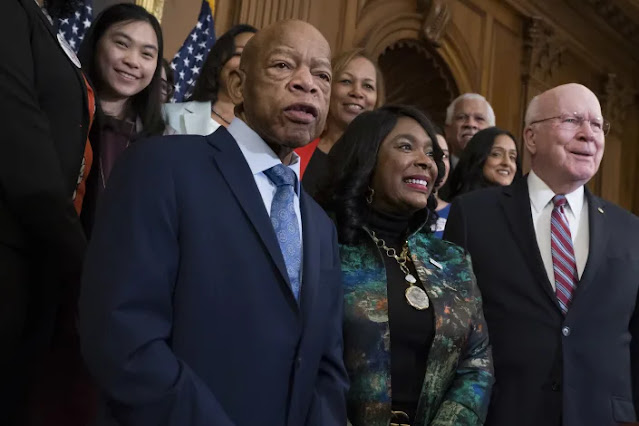
Civil rights leader Rep. John Lewis, D-Ga., Rep. Terri Sewell, D-Ala., and Sen. Patrick Leahy, D-Vt.

For Sewell, “voting rights are deeply personal.” A native of Alabama’s so-called Black Belt, she has roots that run as deep as the rich black soil that helped define the region. She was raised with two brothers by a librarian mother and a father who was a teacher and coach.

“I’m a daughter of Selma,” said Sewell, whose 7th Congressional District also includes Birmingham, Montgomery and Tuscaloosa, as well as smaller rural enclaves. “I stand on the shoulders of freedom fighters and foot soldiers.”

One of them was Amelia Boynton Robinson, the organizer who in 1964 became the first Black woman to seek a congressional seat in Alabama. She was beaten unconscious during the bridge protest. In 2015, Boynton was Sewell’s guest at President Barack Obama’s penultimate State of the Union address. “She joined the march that year and died months later at 103,” Sewell said.

On that fateful morning decades before, Boynton and fellow marchers started out at Brown Chapel African Methodist Episcopal Church in Selma. Sewell’s family has worshiped at the church, now a national historic landmark, for decades. It was where she first met Lewis and many in the movement as a youngster.

After Sewell’s historic election to Congress, Lewis became a mentor on Capitol Hill and a close friend. She fondly called him the “Boy from Troy,” referring to King’s nickname for Lewis, a native of Troy, Alabama. Lewis dubbed his protégé the “Girl from Selma” in return.

They served together on the powerful House Ways and Means Committee; Sewell was recently named a co-chair of its new Racial Equity Initiative. In 2013, the two sat side by side in the gallery as the Supreme Court heard oral arguments in the case Shelby County v. Holder. For decades, the Voting Rights Act helped ensure equal access at the ballot box by requiring states and localities with histories of voter discrimination to get preclearance from the Justice Department before they could change their voting laws.

The Shelby case stripped “key provisions” of the landmark legislation, Sewell said. Then, last year, “the court’s ruling on Brnovich v. DNC” further gutted the law.

According to the Brennan Center for Justice at New York University School of Law, legislatures have introduced more than 400 bills in 49 states that Democrats contend would restrict access to the ballot and disproportionately affect voters of color. The GOP and supporters have termed them voter integrity measures, and dozens have become law.

In Alabama alone, 23 bills have been introduced “that would allow for excessive voter purging, permit racial and partisan gerrymandering, and encourage voter intimidation, and implement stricter voter I.D. requirements,” leaders of multiple civil rights organizations said a recent statement.

Sewell said bolstering federal voting law is especially critical given the 2022 midterm elections and the congressional redistricting cycle.

The Supreme Court halted a lower court order last month requiring Alabama to redraw its new congressional map. Last year, a panel of federal judges struck down the map because it did not provide for two majority-minority districts. While Black people are about 27 percent of Alabama’s population, they are represented in only one of its seven congressional seats.

“The court order is yet another blow to the fight for fair Black political representation that is at the heart of the Voting Rights Act of 1965,” said Sewell, a co-chair of the Congressional Voting Rights Caucus and a co-chair of the Congressional Black Caucus’ Voting Rights Task Force. “The ruling allows the votes of Black Alabamians to be diluted and further undermines Section 2 of the VRA.”

Previous versions of H.R. 4 have also passed the House but faltered in the Senate. The bill was renamed for Lewis after his death on July 17, 2020. It would restore a section of the Voting Rights Act that stopped discriminatory voting changes before they were implemented, restore another section to remedy denial of voting or dilution of the right of people of color to vote, expand voting access (that is, early voting and same-day voter registration), establish Election Day as a federal holiday, ensure access for people with disabilities and more.

“It would re-establish much-needed federal oversight to ensure that minority voters are fairly represented,” Sewell said.

While advancing federal voting rights has been a major focus for Sewell, so have issues like jobs, education and health care access.

Helping her constituents access Covid-19 care and other health conditions has also been a priority. She watched her father, Andrew Sewell, who died in 2017, battle a series of strokes. Her mother, Nancy Gardner Sewell, the first Black woman on Selma’s City Council, died in June. Like Lewis, she had pancreatic cancer.

Sewell is lead sponsor of a measure that would help ensure that new, innovative blood-based cancer screenings are covered by Medicare after they are approved by the Food and Drug Administration. She was invited to the White House for President Joe Biden’s announcement of the relaunch of the Cancer Moonshot.

Sewell, who also holds degrees from Princeton and Oxford, has championed Alabama schools and colleges. As vice chair of the Bipartisan Congressional HBCU Caucus, she has sought increased funding and support for Tuskegee University, Alabama State University and other nearby institutions.

Ever mindful of the sacrifices of civil rights heroes — many of them unsung — she says she views what has transpired around voting rights as a roadblock, not the end of the road. For example, New York is considering its own version of the John R. Lewis Voting Rights Act.

Sewell, who is up for re-election this year, vowed that if voters return her to the 118th Congress, she plans to reintroduce the bill.

“Change rarely comes in the halls of Congress without agitation,” said Sewell, who said she believes senators have to be pressured and that the public must “mobilize, organize” to revamp voting rights. “We can be disappointed or frustrated. But we must never be deterred. Your vote does matter.

“History doesn’t end here,” she added. “As long as I have breath in my body, I will continue to fight for voting rights.”

Saturday, March 12, 2022

Justice Thomas slams cancel culture, 'packing' Supreme Court

U.S. Supreme Court Justice Clarence Thomas said he's concerned efforts to politicize the court or add additional justices may erode the institution's credibility, speaking Friday in Utah at an event hosted by former Republican U.S. Sen. Orrin Hatch’s foundation.

In this Nov. 30, 2018 photo, Supreme Court Associate Justice Clarence Thomas sits for a group portrait at the Supreme Court Building in Washington. Justice Thomas participated at a "fireside" chat in Salt Lake City hosted by former Sen. Orrin Hatch's foundation, Friday, March 11, 2022.

Thomas, the most senior justice on the nine-member court, said he often worries about the long-term repercussions of trends such as “cancel culture” and a lack of civil debate.

“You can cavalierly talk about packing or stacking the court. You can cavalierly talk about doing this or doing that. At some point the institution is going to be compromised,” he told an audience of about 500 people at an upscale hotel in Salt Lake City.

"By doing this, you continue to chip away at the respect of the institutions that the next generation is going to need if they’re going to have civil society," Thomas said.

Rulings for the upcoming year will set laws on hot-button political issues, including abortion, guns and voting rights.

The court has leaned increasingly conservative since three justices nominated by former President Donald Trump joined its ranks. Progressives have in turn called to expand the number of justices on the court, including during the 2020 presidential primary. Democrats in Congress introduced a bill last year to add four justices to the bench, and President Joe Biden has convened a commission to study expanding the court.

“I’m afraid, particularly in this world of cancel culture attack, I don’t know where you’re going to learn to engage as we did when I grew up,” he said. “If you don’t learn at that level in high school, in grammar school, in your neighborhood, or in civic organizations, then how do you have it when you’re making decisions in government, in the legislature, or in the courts?”

In addition to condemning “cancel culture,” Thomas also blasted the media for cultivating inaccurate impressions about public figures — including himself, his wife and late Supreme Court Justice Antonin Scalia.

Ginni Thomas, Justice Thomas’s wife and a longtime conservative activist, has faced scrutiny this year for her political activity and involvement in groups that file briefs about cases in front of the Supreme Court, as well as using her Facebook page to amplify partisan attacks.

As Congress prepares to hold confirmation hearings for Judge Ketanji Brown Jackson, Thomas recalled his 1991 confirmation process as a humiliating and embarrassing experience that taught him not to be overly prideful. During congressional hearings, lawmakers grilled Thomas about sexual harassment allegations from Anita Hill, a former employee, leading him to call the experience a “high tech lynching.”

If confirmed, Jackson would be the first Black woman on the court, and would join Thomas as its second Black justice.

Thomas, who grew up in Georgia during segregation, said he held civility as one of his highest values. He said he learned to respect institutions and debate civilly with those who disagreed with him during his years in school. Based on conversations he’s had with students at his university lectures in recent years, he said he doesn’t believe colleges are welcoming places for productive debate, particularly for students who support what he described as traditional families or oppose abortion.

Thomas did not reference the future of Roe v. Wade, the landmark 1973 Supreme Court decision that extended abortion rights throughout the country. The court this year is scheduled to rule on Dobbs v. Jackson Women’s Health Organization and whether Mississippi can ban abortions at 15 weeks. While the court deliberates over the case, lawmakers in Florida, West Virginia and Kentucky are advancing similar legislation hoping the court overturns Roe and establishes new precedent.

‘You will see the wrath’ — Progressives warn Biden against cutting down agenda

President Joe Biden’s vision for building a vast "care economy" has collapsed — and Democrats fear their party’s political advantage with parents and caregivers could end up as collateral damage.

More than a year into his term, Biden’s plan to invest hundreds of billions of dollars into child and eldercare programs is on the congressional backburner. An expanded tax credit that dramatically reduced child poverty expired and is unlikely to be revived. And the administration’s ambitions for guaranteeing free pre-kindergarten and paid family leave are struggling to gain widespread traction in Congress.

‘You will see the wrath’ — Progressives warn Biden against cutting down agenda

Making matters worse: There’s little public talk of resuscitating these items. In fact, Democrats seem to be girding themselves for a deal in which they are removed entirely from the president’s Build Back Better bill in favor of a pared-down version that funds climate change initiatives and reduces the deficit.

The situation has alarmed liberal advocates and unnerved Democrats who believe winning the support of parents is key to keeping control of power in Washington. Caregivers already exhausted by the pandemic now face rising prices due to historic inflation, with no relief in sight. Republicans, sensing an opening, are attempting to make fresh inroads on education and children’s issues — largely by waging campaigns around curriculums and sexual orientation and gender identification instructions in the classroom.

“They cannot return home for a midterm election without bringing home the goods,” said April Verrett, president of long-term care worker union SEIU Local 2015, who has met frequently with White House officials on the matter. “Americans want and need the support to lower costs for families.”

Democrats’ hopes on this front rely largely on winning over the party’s main holdout, Sen. Joe Manchin (D-W.Va.). But Manchin is focused on limiting drug prices and advancing climate programs, regarding the rest as “social” spending that should be considered only if there’s money left over. And after months spent trying to win the Senator’s elusive vote, many congressional Democrats are signaling they’re willing to give in to his demands.

Advocates for the care provisions have warned the White House and lawmakers that any reconciliation bill that leaves out large investments in the care economy risks alienating one of Democrats' most important voting groups ahead of the midterms. A Morning Consult/POLITICO poll conducted in February found that Democrats had already begun ceding their electoral advantage among recipients of the expanded child tax credit within a month of the payments expiring.

“If a reconciliation package passes without any of the care agenda items, you will see the wrath of women around the country,” said Julie Kashen, director of women’s economic justice at the Century Foundation.

And while members of Congress who have been working on caregiver issues continue to speak optimistically, they acknowledge the skepticism that a deal will be made.

"It will remain a big priority for us," said Rep. Brendan Boyle (D-Pa.). "But I am nervous about whether or not those provisions ultimately make it into something that can pass the Senate."

The current status of the expanded child tax embodies the vise Democrats now find themselves in. The program was passed as part of the Covid relief plan passed last spring, granting families up to $3,600 per child in monthly payments. But it expired in December. Then the main vehicle for its extension — the Build Back Better bill — faltered, and Congress is unlikely to strike a deal this year to restore it, even in a reduced fashion.

Two people close to the process blamed the lack of progress on GOP obstruction, along with Manchin’s reluctance to keep the program going despite its link to plunging child poverty rates. But they also said the administration is largely disengaged from negotiations on Capitol Hill.

There is no point person in charge of getting the expanded tax credit renewed, and the White House has refused to say what concessions it could accept to make a fix more palatable to Republicans and Manchin — making it difficult for lawmakers to hash out specifics. That's left some privately resigned to the probability an agreement is out of reach.

"I'm amazed at the lack of strategy," said one advocate in close touch with the White House. "There's a debate about the future of children and families going on, and they've taken a step back on it."

White House officials are aware of the concerns about the president’s care agenda and try to assuage those fears by saying the president will keep looking for ways to pass the issues into law if they don’t end up in the BBB bill that can be done through reconciliation. During a Friday speech to House Democrats, Biden pleaded with lawmakers to continue working on reducing childcare costs, insisting that "we can do that."

But avenues for passage through a 60-vote threshold in the Senate are, as of now, non-existent. And in a response to a series of questions about its strategy for advancing the issue, the White House declined to comment.

Others told POLITICO that the White House has continued to reassure them that there's still a chance of securing funding for certain items, like universal pre-K and capping childcare costs — emphasizing that the issues are still major priorities for Biden evidenced by their inclusion in his State of the Union address.

“There were a lot of things that were not included in that list of three priorities for Congress to address through a reconciliation bill that he wants on his desk,” said Charles Joughin, who leads public affairs for the child advocacy group First Five Years Fund.

Yet even under that scenario, progress could take months.

While the administration has carefully guarded the details of its talks with Manchin, for fear of leaks that could derail the delicate discussions, officials have indicated it may take until the end of April for negotiations on the specifics of an economic package to begin in earnest.

A person familiar with the White House’s thinking told POLITICO, “The White House is not setting deadlines.”

The delay means that Democrats are likely to head into the campaign stretch either still in the messy negotiation phase or having made little headway on a “care economy” initiative that once formed the backbone of Biden’s Build Back Better agenda.

The expanded child tax credit is hardly the only place where progress has faltered. The White House also initially sought funding to upgrade child care facilities and create a nationwide pre-K program. It wanted to guarantee 12 weeks of paid leave and cap the cost of childcare for low-to-middle income families. Another $400 billion was planned for home and community-based care for older Americans and people with disabilities.

Those initiatives would slash families’ biggest expenses and grow the economy overall, supporters argue, chiefly by allowing more stay-at-home caregivers to re-enter the workforce. Democrats also hoped it would aid them politically, shoring up support among those managing the brunt of the pandemic: suburban women voters who also helped Biden take the presidency in 2020 and people of color who make up a core part of the party’s base.

Instead, that early optimism has been replaced by warnings that Democrats are blowing it.

“Republicans are well aware that parents are going to be a highly contested demographic this cycle, and so they’ve ramped up culture war messaging aimed at this group,” said Ethan Winter, a senior analyst at progressive polling firm Data for Progress, pointing to GOP efforts in Congress and several states to redefine fights over school curricula, gender identity and Covid policies as "parents rights" issues.

There are signs the administration shares the urgency of the advocacy community. Earlier this week, a fact sheet circulated by the White House ahead of the one-year anniversary of its American Rescue Plan credited the law for driving child poverty to its lowest rate on record.

Yet that point is quickly losing its political salience. With the payments drying up, new Columbia University research indicates child poverty is on the rise again — especially among Latino and Black children who saw the greatest benefits last year.

On a Tuesday call with reporters to tout the law’s accomplishments, White House officials declined to say whether they saw a path to restoring the tax credit.

“This is something that we are still fighting for and haven’t given up,” a senior official said.

In the absence of clear momentum, some Democrats have pushed congressional leaders to hold voters on individual proposals even if they’re unlikely to pass, so lawmakers can at least register their support. But that tactic won’t do much to deliver the on-the-ground benefits that Biden promised — and that Democrats once hoped would boost their chances in November.

“We have to define what the parents agenda is,” said Celinda Lake, one of Biden’s campaign pollsters. “We need a more visible fight on this.”

‘Arsonists with keys to the firehouse’: once-obscure state races fuel fears for US democracy

Last year, Brad Raffensperger was attracting national headlines for taking a stand against Donald Trump and his lies about the 2020 election.

Photograph: Brynn Anderson/AP

In a phone call that was quickly made public, Trump demanded that Raffensperger, Georgia’s Republican secretary of state, “find” enough votes to deprive Joe Biden of a victory in the battleground state. Raffensperger refused to do so and won widespread praise for his courage.

Raffensperger is paying for his actions in a way that reveals how his once obscure elected position is now at the center of a battle for the future of American democracy – and attracting all the big money and political heat that entails.

This year, Raffensperger is facing a brutal primary race against a Trump-backed candidate, the US congressman Jody Hice, and trying to cling on to his job. Hice, who has said the 2020 results in Georgia would have been different if the race had been “fair”, has already raised more than twice as much money as Raffensperger.

Hice’s impressive haul is partly thanks to the unusually high number of out-of-state donations that his campaign has attracted, as more Americans across the country zero in on secretary of state races.

And Georgia is not unique. As Trump and his allies continue to spread the “big lie” of widespread fraud in the 2020 race, many voters are focusing their attention – and wallets – on the officials who oversee states’ elections.

Secretary of state candidates in both parties are now posting substantial fundraising figures, intensifying concerns over how election administration has become a heated political issue in the US.

Secretary of state races have historically attracted little notice and even less money. The winners of these elections assume rather bureaucratic roles, and their duties may include managing state records, overseeing the department of motor vehicles and keeping the state seal. But in many states, the secretary of state also serves – crucially – as the chief election official.

In the weeks after the 2020 election, as Trump and his supporters falsely claimed the results had been tainted by fraud, secretaries of state in key battleground states became the target of intimidation and threats. Now the former president is using the power of his endorsement to wield influence in the races for those posts.

While Trump did not endorse any candidates for secretary of state in 2020, he has already endorsed three in the 2022 cycle: Hice in Georgia, Mark Finchem in Arizona and Kristina Karamo in Michigan. All three candidates have embraced the lie that Democrats stole the 2020 election by allowing fraud to affect the results. Biden’s margin of victory in each of those states was less than three points, and their input could prove decisive in the next presidential election.

“They are willing to overturn the will of the voters in order to choose the winner,” said Kim Rogers, executive director of the Democratic Association of Secretaries of State. “It is disempowering, and it is akin to giving an arsonist keys to the firehouse.”

Republicans and Democrats’ disparate concerns over election fairness have contributed to a significant increase in donations to secretary of state candidates.

According to an analysis by the Brennan Center for Justice, donations for secretary of state races in six battleground states are three times higher than they were at this point in the last election cycle, in 2018, and eight times higher than the 2014 cycle. Fundraising has particularly increased in Arizona, Geor­gia and Michigan, which also happen to be the three states where Trump has issued an endorsement.

“A lot more money is going to these once sleepy, bureaucratic races,” said Ian Vandewalker, senior counsel in the Brennan Center’s elections and government program. “The places that we’ve seen the biggest increase – which is basically Arizona, Georgia and Michigan – each of those places had some degree of nationally covered election controversy around 2020.”

Mark Finchem, seen here at a Trump rally, is running for secretary of state in Arizona. Photograph: Rachel Mummey/Reuters

The Brennan Center analysis also indicated that out-of-state donations to secretary of state candidates are increasing at an even faster rate than overall donations. Finchem, who has called on the Arizona legislature to decertify the 2020 presidential results in three major counties, already has six times as many donors as every secretary of state candid­ate in the 2018 elec­tion combined. Two-thirds of those donors live outside Arizona.

Democrats have taken note of Republican enthusiasm about secretary of state elections, and they are responding by ramping up their own fundraising.

The Democratic Association of Secretaries of State and its partner groups raised a record $4.5m in 2021, compared with $1.5m raised during the entire 2018 cycle. The organization has said it is on track to meet its fundraising goal of $15m for the 2022 cycle, in part because of the increase in first-time individual donors. Other progressive groups, including End Citizens United and iVote, have pledged to spend tens of millions more on secretary of state races this year.

“The engagement is at every single level. We have seen a massive increase in our email list and grassroots support,” Rogers said.

Rogers believes Democratic activists are increasingly turning their attention to secretary of state races partly because they have been frustrated by the lack of progress at the federal level. Congressional Democrats have repeatedly tried to pass national voting rights legislation, which would reverse some of the voting restrictions enacted by 19 states last year, but Senate Republicans have successfully used the filibuster to defeat those bills.

“I think there are a lot of activists who got involved in 2020 who fought incredibly hard for the federal voting rights legislation in 2021,” Rogers said. “When 50 Republicans blocked it yet again, folks were looking for a way to stay engaged and to continue the fight, and they shifted their assets into the states.”

Republicans complain that Democrats are trying to alter election regulations to their benefit at both the federal and state levels. Andrew Romeo, communications director for the Republican State Leadership Committee, said Democrats were “ramping up their interest in secretary of state races because they see control of these offices as a way to change the rules to compensate for their inability to win elections”.

Romeo’s group is an umbrella organization that promotes Republican candidates for state legislatures, state supreme courts and secretary of state offices, among other roles. The RSLC and its policy partner group raised $33.3m in 2021, exceeding their previous odd-year record by more than $14m.

But to Democrats like Rogers, the outcome of secretary of state races in key battleground states represents nothing less than the fate of American democracy.

“These folks want to rig the game, and they are out to do that,” Rogers said.

Vandewalker fears that the increasingly dire messaging about secretary of state races will contribute to a political climate in which both parties distrust the outcome of elections.

“Money and attention being paid to these races is not inherently a bad thing. The voters should be informed about these candidates,” Vandewalker said. But he adds, “that kind of rhetoric is extremely dangerous to voter confidence because of course one side or the other is going to win and is going to count the votes. And democracy counts on people accepting the result, even if their side doesn’t win.”

Friday, December 02, 2016

Sarah Olney Interview in Richmond Park

And in terms of the tone of the whole brexit debate and I'm joined now by the newly elected MP Sarah Olney all the congratulations of what do you think you did manage to overturn. 23000 majority.

Sarah Olney Interview in Richmond Park
Well we started the campaign talking about our opposition to Heathrow expansion because that's when the by election was cool about it as we went round talking to voters we realize the bricks that was something that mattered a great deal more to them that's a lot of anxiety a lot of people very disappointed in the result so you know we started to get out a message about it we've always have a. St pro European has only come in very hard for remain and that went down really well with the voters now you said that you will actually vote against triggering article 50 to stall the bricks that negotiations.

That may be something that'll please some of your photos here but surely it is flying in the face of the views of the majority of people who voted to leave when I made that a central part of my campaign here in Richmond park and now that I've been returned to parliament it gives me a personal mandate from I have photos that I represent too to oppose article 50. But this constituency is not representative the whole country 70 percent have voted to remain pre know what the bricks that result is sure we've got to accept that. Well you know as I say you know I've got a very clear mandate from the constituents I represent and you know it say it's a Monday it they voted 70 percent remain anyway and now I've got a very clear Monday. This is an extraordinary victory but it's not going to make any difference really is it to the course of the brexit negation they go see Asians and to the government's determination to deliver on those with the will of the British people.


Well you know we just take the time to a massive 23.5000 majority here and it was very clearly a case of people voting against 2 reason Mase current approach to Brecht's it so I think that will give her polls as she can she. She will see now she's using both she's lost a seat that was previously a very safe seat for the Tories and I hope that that will cause it to change her mind about her current approach to Brecht's it. What about liberal democrats'you still love a pretty small full so Westminster you don't really gotta be able to do too much to change what is that all you well you know the momentum is with this people voting liberal democratic and not just in this election but in many council elections have been held since last year and I think in future elections we got some excellent candidates lined up I'm I think. I think we can we can win more seats.

But you're still a very small schools we've got you kept saying that that game to make gains. Approaching this whole brexit process from a completely different. Approach. Well I think to be honest I think to reason may has probably been too influenced by the UKIP and of the political spectrum and I think what this victory yesterday represents is. Is that you know she's to she needs to look out for the live with Democrats as well because we are providing now strong opposition only remain side of the political debates and that that's winning US boats and it's winning a seats there only thank you very much indeed for talking to ramble what's clear is that it wallows that whole issue of Europe on brexit which swung the did his decision here it was is that a pull the LibDems another new MP that's certainly Kohut that's it for now from Richmond. Carol thank you very much!